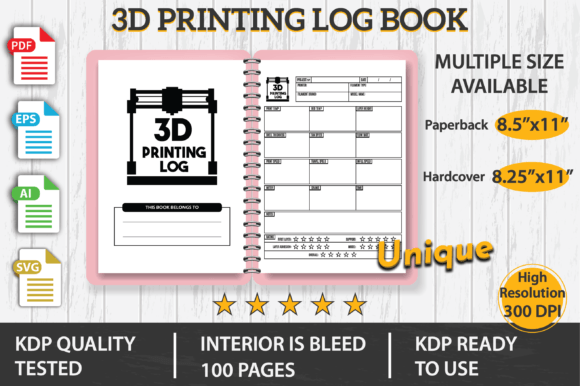
3D Printing Log Book KDP Interior
A Designer’s First Look: Clean, Niche, and Quietly Confident
When I opened 3D Printing Log Book KDP Interior, my first thought wasn’t “Oh, another tech-themed graphic.” It was, “This feels like a notebook you’d actually want to hold—structured, intentional, and quietly proud of its craft.” The layout leans into functional minimalism: clear margins, balanced white space, and typography that reads as both technical and approachable. There’s no visual noise—no forced gradients, no over-rendered 3D effects, no cartoonish icons. Instead, it offers clean lines, consistent spacing, and subtle hierarchy that suggests professionalism without stiffness. As an embroidery designer who regularly adapts graphics for stitch, I immediately saw how this would translate: crisp letterforms, generous negative space around key elements, and a scale that breathes on fabric rather than crowds it.
Where This Design Lives Best in Real Embroidery Projects
I recently used a version of 3D Printing Log Book KDP Interior on a small-batch run of cotton twill aprons for a local makerspace pop-up. We stitched it onto the left chest—small hoop, medium-density fill stitch, black thread on natural fabric. It landed perfectly: legible at arm’s length, tactile but not bulky, and unmistakably *for* makers. That’s where this design shines—not as a standalone logo, but as a quiet signature on products made *by* people who build, tinker, and document. Think embroidered tote bags for engineering students, baby onesies for maker parents (“Future Print Engineer”), sweatshirt backs for Fab Lab staff, or pillow covers for home offices with 3D printers humming in the corner. It also works beautifully as a digital embroidery file for printable mockups—Etsy sellers can drop it into lifestyle shots and instantly signal credibility to a very specific, highly engaged audience.
What Holds Up—and What Needs Extra Care
The strength of 3D Printing Log Book KDP Interior is its restraint. Because it avoids dense ornamentation or ultra-thin strokes, it handles common embroidery challenges well: it scales cleanly down to a 3-inch hoop for caps or patches; holds clarity on textured fabrics like canvas or terry cloth; and reads clearly on dark fabric when paired with high-contrast thread. That said, I always test small details first—especially any fine numerals or punctuation in the log book title. On stretchy fabric (like ribbed knit sweatshirts), I add light cutaway stabilizer beneath the hoop to prevent puckering around text blocks. And while the design doesn’t rely on satin-stitch borders or delicate applique elements, I still check stitch density in the preview software—if the fill areas feel overly dense for lightweight cotton, I’ll adjust underlay or reduce density by 5–7% before stitching.
Smart Use Cases for Craft Business Owners
- Personalized gifts: Add a name or date below the main title for graduation, internship completion, or shop anniversary—stitched neatly on a tea towel or kitchen apron.
- Etsy listings: Bundle the 3D Printing Log Book KDP Interior as part of a “Maker Starter Kit” digital download—including matching SVGs, PDF log pages, and embroidery-ready files.
- Boutique merchandise: Pair it with neutral-toned apparel (heather grey sweatshirts, oatmeal tote bags) to reinforce brand consistency for STEM-focused shops or educational studios.
- Holiday embroidery: Stitch it onto linen pillow covers or flannel blankets as low-key, thoughtful gifts for engineers, teachers, or hobbyists—no glitter, no clichés, just quiet recognition.
Design Integrity Meets Commercial Practicality
As someone who reviews hundreds of digital embroidery files a year, I notice fast which ones elevate a handmade product—and which ones dilute it. 3D Printing Log Book KDP Interior falls firmly in the first group. Its visual personality supports, rather than competes with, the quality of the finished product. Customers don’t see “generic clipart”—they see intention. That builds trust, especially for Etsy sellers or small shop owners whose buyers care about authenticity. It also strengthens brand consistency: whether you’re selling embroidered patches, printable planners, or custom apparel, this design anchors your offerings in a shared language of craftsmanship and curiosity.
Essential Embroidery Designer Notes Before You Stitch
- Always test 3D Printing Log Book KDP Interior on scrap fabric first—especially if using textured, stretchy, or dark materials.
- Review thread color contrast in both light and dark mockups. Black or navy works reliably on light backgrounds; cream or charcoal adds warmth on dark fabric.
- Confirm hoop size compatibility. While the layout is flexible, tight corners or narrow margins may require slight repositioning depending on your machine’s throat space.
- Inspect small details at 200% zoom in your embroidery software—look for stray anchor points or overlapping vectors that could cause stitching hiccups.
- Use appropriate stabilizer: tear-away for stable wovens, cutaway for knits or lightweight cottons, and topping for napped fabrics like fleece or terry.
- Verify licensing terms before selling finished items or bundling the design as part of a commercial embroidery project—Kdp Interiors and Graphics categories often carry specific usage rules.
- Check whether the file includes alternate versions (e.g., simplified line art or monochrome variants) for maximum versatility across product types.
Final Thought: A Design That Serves the Maker, Not Just the Market
This isn’t flashy. It won’t go viral on Pinterest—but it will earn repeat orders from customers who value precision, clarity, and quiet confidence. Whether you’re stitching a single personalized gift or building a full line of maker-branded merchandise, 3D Printing Log Book KDP Interior delivers what so many embroidery designs miss: respect for the craft, the wearer, and the real-world context where it lives. In short—it stitches well, sells honestly, and feels like it belongs.