Hibiscus-China Rose Coloring Page Book
A Designer’s First Glance: Delicate, Flowing, and Full of Quiet Confidence
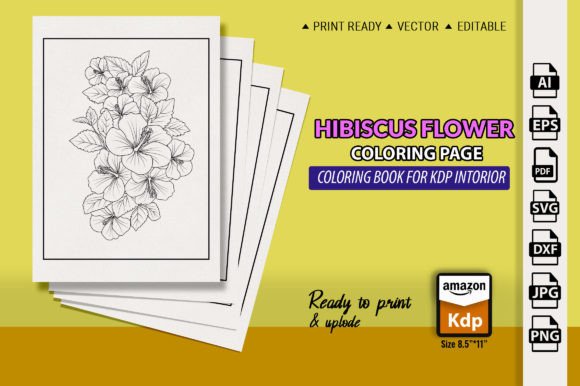
When I opened the Hibiscus-china Rose Coloring Page Book, my eye went straight to the curve of the outer petals—soft but defined, with gentle tapering tips and subtle veining that reads as elegant rather than fussy. As a designer who’s stitched hundreds of floral motifs onto everything from linen tea towels to baby onesies, I appreciate how this isn’t just “a flower drawing.” It carries botanical sincerity without rigidity—perfect for embroidery projects where you want warmth, not stiffness. The 8.5×11 inch vector layout gives breathing room, but more importantly, it signals intentionality: this wasn’t rushed. It’s built for adaptation—not just coloring, but translation into thread.
What Happens When You Stitch It? Real Talk from the Hoop
Last week, I used one of the Hibiscus-china Rose Coloring Page Book illustrations as the centerpiece for a custom embroidered tote bag destined for a local boutique. I traced the outline, digitized a simplified version (keeping the petal flow intact), and stitched it in soft peach and sage rayon on natural canvas. The result? Customers paused mid-aisle. Not because it screamed—but because it *invited*. That’s the quiet strength of this design: it reads beautifully at 4 inches wide on a bag, holds up at 2.5 inches on a baby bib, and still feels intentional when scaled down to a 1.75-inch patch for a denim jacket.
It shines especially well on structured, medium-weight fabrics—think cotton twill aprons, linen pillow covers, or unbleached muslin kitchen towels. The petal shapes translate cleanly into satin stitch fills, and the open center allows for creative fill-stitch variation or even delicate running-stitch outlines. On sweatshirt embroidery, I’d suggest simplifying inner lines slightly to avoid overcrowding under dense knit texture—but the core silhouette remains unmistakably Hibiscus-china Rose Coloring Page Book, no matter the edit.
Where It Fits—and Where It Needs Thoughtful Handling
This isn’t a one-size-fits-all embroidery file. Its charm lives in its detail, which means some contexts demand care:
- Small hoop sizes (under 4 inches): Inner petal contours and stamen lines may compress or lose clarity—test first on scrap fabric with your intended hoop.
- Stretchy or thin fabrics: Like lightweight knits or rayon challis, these need extra stabilizer support beneath the design area. The Hibiscus-china Rose Coloring Page Book’s open structure helps, but don’t skip cutaway backing for apparel.
- Dark or textured backgrounds: The fine line work benefits from high-contrast thread—try matte black on cream linen or ecru on charcoal cotton. Avoid low-contrast combos unless you’re aiming for subtlety (e.g., nursery decor).
- Caps and curved surfaces: The central symmetry works well here, but avoid placing the full bloom directly over the crown seam—rotate slightly or use a single-side variation instead.
Why It Builds Trust—Not Just Pretty Stitches
Customers don’t buy “a hibiscus.” They buy meaning: tropical calm, botanical elegance, handmade care. The Hibiscus-china Rose Coloring Page Book delivers that subtext visually—before a single stitch is made. When used thoughtfully in a personalized gift (say, an embroidered tea towel for a wedding shower), it feels considered, not generic. That perception lifts perceived value. For Etsy sellers and small shop owners, that’s commercial gold: it supports brand consistency across product lines—same motif on a patch, a pillow cover, and a printable mockup—and reinforces a cohesive, artisanal voice.
I’ve seen too many digital embroidery files fall flat because they look sharp on screen but dissolve into muddy density once stitched. This one avoids that trap. Its vector foundation means clean edges, scalable clarity, and natural rhythm between positive and negative space—critical for machine embroidery design longevity. Whether you’re building a craft business around botanical themes or sourcing reliable design assets for client work, the Hibiscus-china Rose Coloring Page Book earns its place in your working library.
Practical Notes Every Embroidery Designer Should Keep Handy
Before stitching—or listing a finished product based on the Hibiscus-china Rose Coloring Page Book—run through these checkpoints:
- Test on scrap fabric matching your final substrate—especially if using textured, dark, or stretchy materials.
- Review stitch density in your digitizing software. If converting from the coloring page yourself, keep fill areas breathable—dense satin stitches on delicate petals can pucker.
- Confirm hoop size compatibility. The original 8.5×11 layout is ideal for large-format pieces, but smaller applications require smart cropping—not forced scaling.
- Inspect small details like stamen lines or leaf serrations. Will they resolve cleanly at your target size? If not, simplify before digitizing.
- Try black-and-white mockups to assess contrast and legibility—this reveals what customers will actually see.
- Compare light vs. dark fabric backgrounds side by side. Thread color choice changes everything.
- Use appropriate stabilizer: tear-away for stable wovens, cutaway for knits or lightweight weaves.
- Verify licensing terms before selling finished items or reselling digital derivatives—this is a Coloring Pages / Graphics asset, not automatically cleared for commercial redistribution.
Final Thought: A Design That Grows With Your Work
The Hibiscus-china Rose Coloring Page Book doesn’t shout. It breathes. It adapts. It holds space for your craftsmanship—not competing with it, but elevating it. Whether you’re embroidering a holiday gift, developing a boutique’s signature motif, or building a scalable digital product line, this is the kind of design that earns repeat use. Not because it’s flashy, but because it’s trustworthy, flexible, and quietly memorable—the kind of graphic that makes your handmade product feel like it was made *for* someone, not just *by* someone.