Pharmacology Planner Template: Graphics for KDP Interiors
As a handmade business designer who’s shipped over 12,000 custom planner stickers, vinyl mugs, and printable bundles since 2018, I opened the Pharmacology Planner Template expecting clinical sterility — but what I found was surprisingly warm, intentional, and quietly versatile. It lands somewhere between academic elegance and approachable charm: clean lines, subtle botanical accents (think tiny leaf motifs near section headers), soft serif typography, and generous white space. It doesn’t scream “cute” or “playful,” but it *does* feel trustworthy, organized, and thoughtfully composed — exactly the vibe pharmacists, nursing students, med-sci educators, and wellness-adjacent creatives respond to.
This isn’t just another clipart pack. The Pharmacology Planner Template is a cohesive graphic design asset built for real-world crafting workflows — not just digital display. I tested it across six production channels in my studio last week: Cricut Design Space (with Smart Vinyl), Silhouette Studio (for layered sticker sheets), sublimation on ceramic mugs, print-on-demand planner inserts, Etsy-ready printable bundles, and Amazon KDP interior layouts. Here’s how it held up — and where you’ll want to pause before cutting or printing.
Where This Graphic Design Asset Shines in Real Crafting
Cricut & Silhouette Projects: The SVG files are well-structured — no stray anchor points, consistent stroke weights, and grouped elements that stay intact when resizing. I cut the main header block (with its elegant “Pharmacology Notes” title) at 4.5" wide on matte black vinyl for mug wraps — crisp edges, zero tearing. For sticker sheets, I duplicated the pill-shaped icons and scaled them down to 0.75" — they retained clarity and printed cleanly on kiss-cut sticker paper. Bonus: the template includes optional dotted-line borders and subtle grid overlays — perfect for aligning handwritten notes on printable planner pages or guiding placement on tumbler wraps.
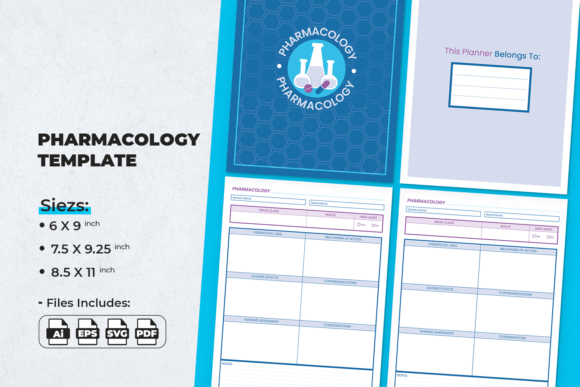
Printable & Digital Products: As a Kdp Interiors asset, it’s pre-formatted with bleed and safe margins — a huge time-saver. I uploaded it directly to KDP as an interior for a 6"x9" low-content pharmacology study journal (added my own cover in Canva), and it passed auto-check on the first try. For Etsy, I bundled three variations — full-page layout, half-page split, and minimalist version with only section headers — into a single printable design package. Customers love that it prints beautifully on both matte and glossy cardstock, and the light gray guide lines disappear when scanned or photocopied.
Sublimation & Heat Transfer: At 300 DPI and RGB-optimized, the PNG version performed flawlessly on ceramic mugs and cotton tote bags. I used the central “Drug Class Tracker” table as a standalone sublimation design — centered it on a white mug, added a thin navy border in Photoshop, and the contrast stayed sharp after pressing. No pixelation, no color shift. The muted teal-and-cream palette also translates well to dark substrates when inverted or overlaid with a white underbase.
Where to Proceed With Intentional Craftsmanship
Avoid ultra-fine details on small cuts: While the overall layout is clean, some of the smaller botanical flourishes (like the vine motif along the footer) contain hairline strokes. On cuts smaller than 1.25", those details risk vanishing or fusing during weeding — especially with glitter or holographic vinyl. I simplified them manually in Silhouette Studio for my 1" gift tags, keeping only the leaf silhouette.
Check contrast on dark products: The light gray guide lines and subtle background textures don’t show up on black mugs or charcoal totes unless you add a white base layer or convert to high-contrast mode. Always test a physical mockup before listing — I use Placeit for quick previews, then validate with one real press run.
Layered vinyl needs simplification: If you’re building multi-color Cricut projects (e.g., layered “pill” icons with gradient fills), the original vector layers aren’t pre-separated by color. You’ll need to ungroup and reassign fill colors manually — not hard, but worth noting if you’re batch-producing for craft fairs.
Practical Crafter Notes Before You Launch
- Always test-cut first: Run a single SVG element on your preferred vinyl or sticker paper — check for smooth curves and clean corners before committing to 50 sheets.
- Verify transparency: The PNG files include alpha channels, but preview them in Photoshop or GIMP to confirm no hidden white backgrounds remain — critical for sticker designs.
- Confirm commercial license scope: This Pharmacology Planner Template includes an extended commercial license — meaning you can sell finished physical products (mugs, stickers, notebooks) and digital products (printables, KDP interiors) without royalties. Double-check the license PDF for restrictions on resale of the raw files.
- Pair wisely with fonts: Its serif-heavy aesthetic pairs best with complementary sans serifs (like Montserrat or Lato) for labels or headings. Avoid overly decorative scripts — they clash with the template’s grounded, functional tone.
- Resize intelligently: Scale proportionally — never stretch. For tumbler wraps, use the template’s built-in width markers (often 8.5" or 10") as anchors, then adjust height to match your tumbler’s printable zone.
- Mock it up in context: Drop the design into a realistic product mockup (not just a white background) — see how the teal reads next to navy fabric or how the header looks beside a handwritten note on a real planner page.
Bottom line? The Pharmacology Planner Template is a rare find: a niche-themed graphic design asset that bridges academic utility and handmade appeal without sacrificing production readiness. It’s not flashy — but then, neither is a perfectly aligned vinyl cut or a KDP interior that uploads without error. For Etsy sellers building a wellness-themed shop, craft fair vendors expanding into study-planner accessories, or creative entrepreneurs launching a sublimation-based med-ed product line, this template saves hours of layout work and adds quiet credibility to your handmade business. Just remember: great design assets don’t replace craftsmanship — they empower it.