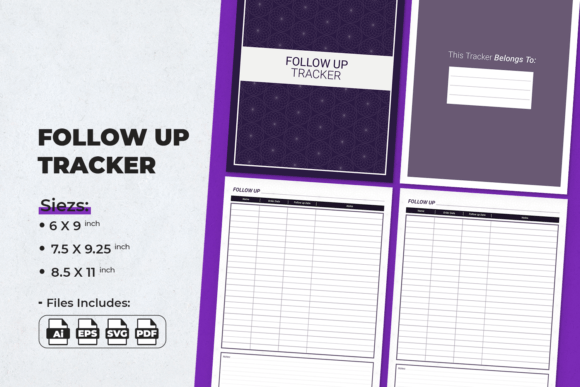
Follow Up Tracker Planner Template
As a designer who’s stitched everything from nursery monograms on organic cotton onesies to boutique tote bags for local craft fairs, I opened Follow Up Tracker Planner Template expecting clean utility—but what stood out immediately wasn’t just function. It’s got quiet confidence: balanced spacing, intentional negative space, and a rhythm in its layout that feels *designed*, not assembled. This isn’t a cluttered checklist—it’s a visual pause button, built for clarity. That matters deeply when translating it into thread.
First Impressions: What This Design *Feels* Like Under Needle
The template carries a calm, grounded energy—think linen tea towel in a sunlit kitchen, not neon gym bag. Its structure leans into soft geometry: rounded corners, consistent line weights, and generous margins. No frantic zigzags or overwrought flourishes. That restraint is a gift for embroidery. When you’re stitching on a curved surface like a cap brim or a baby bodysuit, simplicity reads as precision—not minimalism for minimalism’s sake.
I held it up against a mockup of a heavyweight cotton apron—exactly the kind my Etsy shop sells to bakers and florists. Instantly, I saw how the tracker’s vertical columns would align with seam lines, and how its centered header could anchor a chest pocket without competing with functional stitching. It didn’t scream “embroidery design”—it whispered “this belongs here.”
Where It Shines (and Where It Asks for Thought)
Strong fits:
- Tote bag design — Perfect for side-panel placement. The clean grid scales well at 4–5 inches wide and holds legibility even with medium-weight thread.
- Sweatshirt embroidery — Works beautifully on lower-back or left-chest placements. The open layout avoids dense fill-stitch traps that cause puckering on fleece.
- Personalized gift — Pair it with a name or date above the header for a custom baby milestone tracker on a muslin pillow cover. Feels meaningful, not generic.
- Commercial embroidery — Ideal for small shops offering “planner + personalization” bundles—say, a leather-bound notebook with an embroidered canvas cover using this tracker as the focal motif.
Use with care:
- Small hoop sizes — Don’t force it below 4" x 4". Tight corners and fine divider lines lose definition under 3" hoops, especially on textured fabrics like terry cloth or bouclé.
- Stretchy fabric — Avoid direct application on knits without cutaway stabilizer and reduced stitch density. Those clean horizontal lines can distort if the base fabric gives.
- Dark fabric — The template relies on contrast. If you’re stitching on charcoal or navy, test light-thread options (ecru, pale gray) first—avoid white unless your stabilizer fully prevents shadowing.
- Curved surfaces — Caps and curved mugs (for embroidered sleeves) demand careful digitizing adjustments. This is a PDF template—not a machine embroidery file—so treat it as a guide, not a ready-to-hoop asset.
Design Integrity in Real-World Use
What makes Follow Up Tracker Planner Template feel trustworthy isn’t just aesthetics—it’s how it supports intention. A client ordering embroidered baby milestone trackers doesn’t want flashy graphics; they want warmth, longevity, and quiet usefulness. This design delivers that. Stitched in matte cotton thread on unbleached canvas, it reads as heirloom—not disposable.
It also builds customer trust subtly. Clean alignment signals craftsmanship. Consistent spacing between rows tells buyers, “This was made with attention,” even before they touch the fabric. For Etsy sellers bundling digital + physical products, that perceived value lifts pricing power—no need to discount to move inventory.
And yes—it works for print, too. As a Graphics product under Kdp Interiors, it’s clearly built for low-content books. But don’t overlook its dual-life potential: use the same layout as a printable mockup background for your embroidered tote listings, or layer it behind a satin-stitch border for a hybrid digital/handmade product page.
Practical Designer Notes Before You Stitch
This isn’t a plug-and-play embroidery file—you’ll need to digitize or adapt it. So before committing thread or client time:
- Test the design on scrap fabric *first*, using your exact thread, stabilizer, and fabric combo.
- Check thread color contrast on both light and dark backgrounds—even grayscale mockups reveal legibility gaps.
- Review stitch density if converting to an embroidery file. Avoid heavy fill-stitch areas in narrow columns—they’ll stiffen delicate fabrics like silk or lightweight linen.
- Confirm hoop size compatibility early. That header bar may need slight widening for 5" hoops to prevent edge trimming.
- Inspect small details: Are those checkbox outlines thick enough to hold shape after washing? Will tiny date fields stay readable after 3+ laundry cycles?
- Verify licensing. Since it’s positioned for KDP and low-content use, confirm whether commercial embroidery rights are included—or if you’ll need separate permission to sell finished embroidered goods.
Remember: a great machine embroidery design starts long before the needle drops. It starts with knowing what the end user will feel—not just see. Follow Up Tracker Planner Template earns its place because it respects that chain: designer → stitcher → wearer → keeper. It’s not loud. It’s steady. And in a market flooded with decorative noise, that kind of quiet strength is rare—and highly stitchable.